Add your promotional text...
Conference-Concert
Brain&Music: 3 Magic Molecules
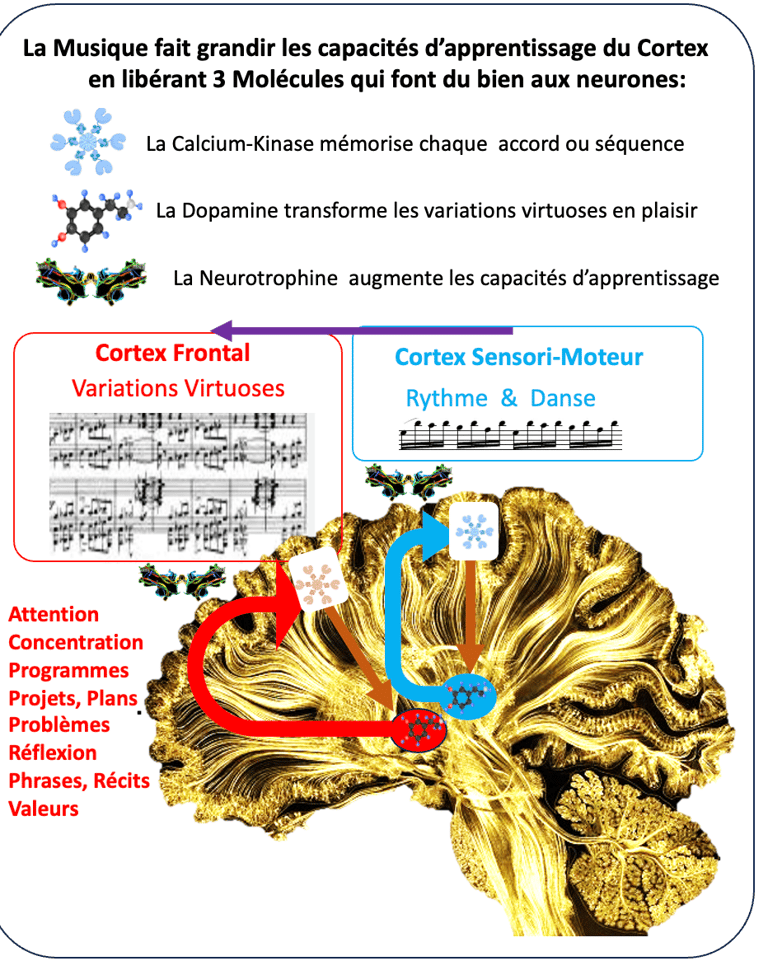
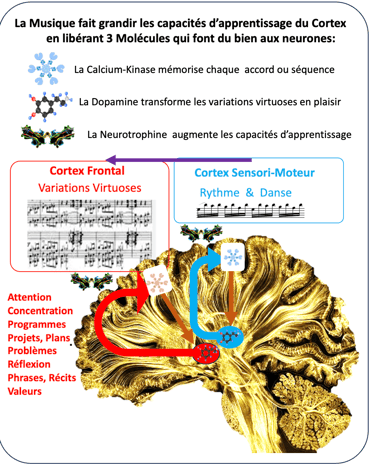
The frontal cortex is the region of the brain that learns attention, concentration, curiosity, reflection, multiple problem solving, long-term project planning, and behavior control. The combination of classical music and virtuosity releases dopamine, which triggers a virtuous cycle of active listening over the long term, making people want to play themselves and develop their own musical practice. This same combination releases neurotrophin over the long term, which causes neurons to grow where they learn, thus causing the neurons of the frontal cortex to grow.
The development of the frontal cortex is most challenging in today's world, given the competition from attention-grabbing stimuli (TV, the internet, influencers) that bombard children's brains and AI that aims to replace this intelligent part of the brain.The conference aims to raise awareness of the powerful effect of classical music on the development of the mental capacities of the frontal cortex. Teaching classical music is an asset in preparing children to master AI so that it becomes a friend to their frontal cortex.
The concert shows how classical music combines the progression of the frontal cortex's abilities with intense pleasure.
The program is chosen to give listeners a sense of the progression in the richness of virtuoso variations, a progression that marks the major stages in the history of classical music. It is the same progression that can be found in the development of increasingly sophisticated abilities in children over the years.
Classical composers can be seen as great discoverers of the wonderful capabilities of our brains, particularly the frontal cortex, which is the seat of attention, concentration, and reflection.
The magical combination of progression and pleasure is brought about by the virtuosity of the performer. Virtuosity makes the ever-increasing richness of the compositions feel like an ever-more intense pleasure.
Georg Handel 1720 Variations on “The Harmonious Blacksmith” Inspired by the rhythmic song of a blacksmith
Wolfgang Amadeus Mozart (1782, aged 25) 12 Variations on “Ah vous dirai-je maman” Popular children's song
Frédéric Chopin (1827 , aged 17) Variation on an aria from Don Juan, opera by Wolfgang Amadeus Mozart (1787) “la ci darem la mano” “we will hold hands”
Leopold Godowski (1894 , aged 24) Variations on Études by Frédéric Chopin (1832-37): Challenge of transferring the theme from the right hand to the left hand
Györgi Cziffra (1950, aged 28, the pianist with 50 fingers) Variations on a theme from Tritsch-Trasch Polka by Johann Strauss Jr. (1858) (Rumor-Gossip in Viennese slang)
Vladimir Horowitz (1968) Variations on a theme from Carmen, opera by Georges Bizet (1874)“Chanson bohémienne”
The Concert: Ulysse Burnod, pianist and violinist,
winner of the first prize in piano at the Brussels Conservatory, composer, musicologist, and conductor, has benefited from the teaching of the great European masters. He invites us on a musical journey through famous pieces from the piano repertoire, revisited by brilliant performers and composers who sought to push the boundaries of their art by inventing daring variations. This quest for innovation led them to explore new dimensions of music that both amplify our mental capacities and intensify our pleasure, transporting us to an enchanting universe. Beyond the classical repertoire, Ulysse Burnod develops his creativity in the art of composition and improvisation.